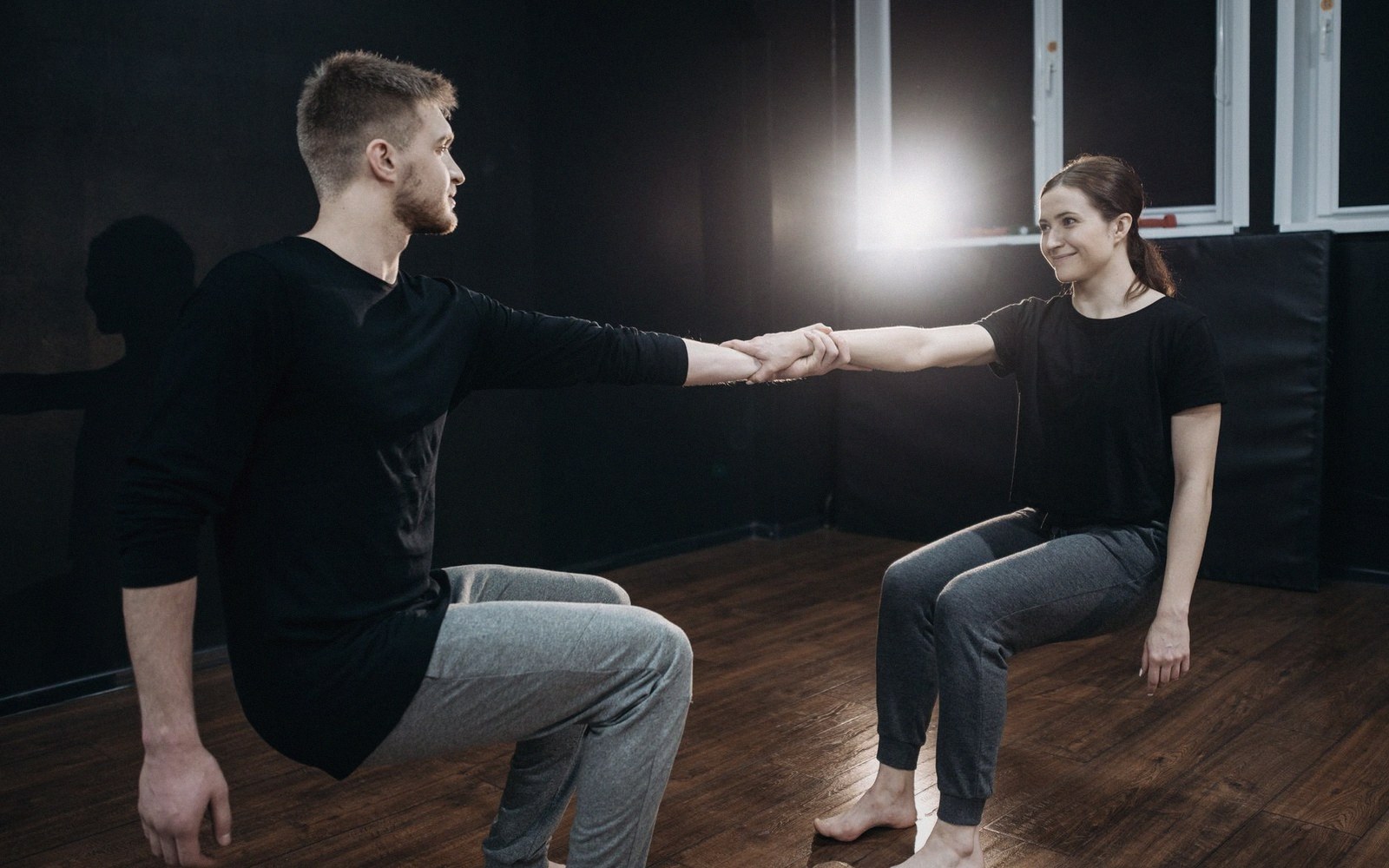
The connection runs both ways. Neither role is done to you — both require listening, timing and a physical decision made every eighth beat.
Most beginners arrive with the same mental image: the leader decides what happens, the follower does it. Neat, hierarchical, wrong. What actually occurs is closer to a conversation in real time, and like any conversation, it requires two active participants.
The leader's job is to make a proposal — a shift in weight, a change in direction, a frame that opens or closes — legible enough that the follower can read it and respond before the beat has passed. That legibility is a technical skill. A leader who yanks, shoves or simply throws their arm somewhere and hopes has not led: they have issued a command with no syntax, and the follower's stumble is the leader's error, not the follower's. Good leading is shaped by the follower's actual body, not a rehearsed sequence. If the follower is slightly behind the beat, an experienced leader adjusts. If a move isn't landing, a leader worth the role feels that in the connection and changes course. Reading the response is half the work.
The follower's job is interpretation, and interpretation is not passivity. The follower hears the music independently of the leader. They have their own pulse, their own axis, their own sense of phrasing. A follower who has genuinely internalized the rhythm brings that timing to the partnership — they do not wait to be placed on the beat by someone else. They also carry the texture of the connection: whether the frame feels elastic or dead, whether momentum is being used or wasted, whether a turn is being completed on their own axis or forced by external pressure. All of that information flows back up through the point of contact, and a leader who is paying attention can feel it. A follower who has stripped all of that information out — who has gone completely limp waiting to be told what to do — has made the leader's job harder, not easier.
The point of contact between two dancers — whether it is a hand-to-hand Lindy hold, a closed ballroom frame, or a single-hand open position — transmits information that neither dancer could put into words fast enough to be useful. This is called tone, and managing it is a skill both roles develop over years.
Too much tone and the connection becomes a wrestling match: both dancers pulling against each other, burning energy on resistance instead of movement. Too little and the frame goes slack, proposals disappear before they register, and the follower is left guessing. The right amount of tone is a maintained, responsive tension — firm enough that a small movement from the leader travels clearly to the follower, light enough that the follower's own weight and momentum can speak back. Finding that middle ground takes hundreds of hours of social dancing with many different partners. There is no classroom substitute for it.
This is why the old teaching shorthand — "leaders, you drive; followers, you're the passenger" — does real damage. A passenger is inert. A follower in a social dance is more like a co-pilot: they are not setting the heading, but they are reading the instruments, managing the energy and flagging turbulence. Strip that agency out and the dance degrades into something mechanical and, frankly, boring to watch and to dance.
A significant portion of the swing dance community practices cross-role learning — leaders spend time following, followers spend time leading — and the pedagogical case for it is strong and practical. When a leader follows for an evening, they feel what a poorly telegraphed proposal actually registers as: a sudden pull, a vague pressure with no clear direction, a change of weight that arrives after the beat. That experience is immediately transferable back to their leading. When a follower leads, they discover how much decision-making is being done on a compressed timeline, and they typically become more generous about ambiguous signals when they return to their primary role.
Cross-role practice also dismantles the myth that one role is the simpler one. New followers sometimes assume they have the easy end of the bargain because they do not have to "think of the patterns." New leaders sometimes assume following is just reacting. Both discover quickly that the role they thought was easier is simply harder in different ways. Leading demands spatial awareness, pattern vocabulary, and the ability to compose in real time. Following demands sensitivity, balance, and the discipline to remain genuinely responsive rather than predicting and jumping ahead of the proposal — a habit called back-leading that collapses the conversation into monologue.
The frame does not lie. Every choice a dancer makes — about timing, about weight, about how much force to apply — is legible to their partner. That transparency is what makes social swing dancing demanding and, when both partners are actually listening, startlingly communicative. It also means you cannot fake competence in either role for long. You develop both by paying attention, dancing with a wide range of partners, and resisting the temptation to decide the other role must be easier than yours.