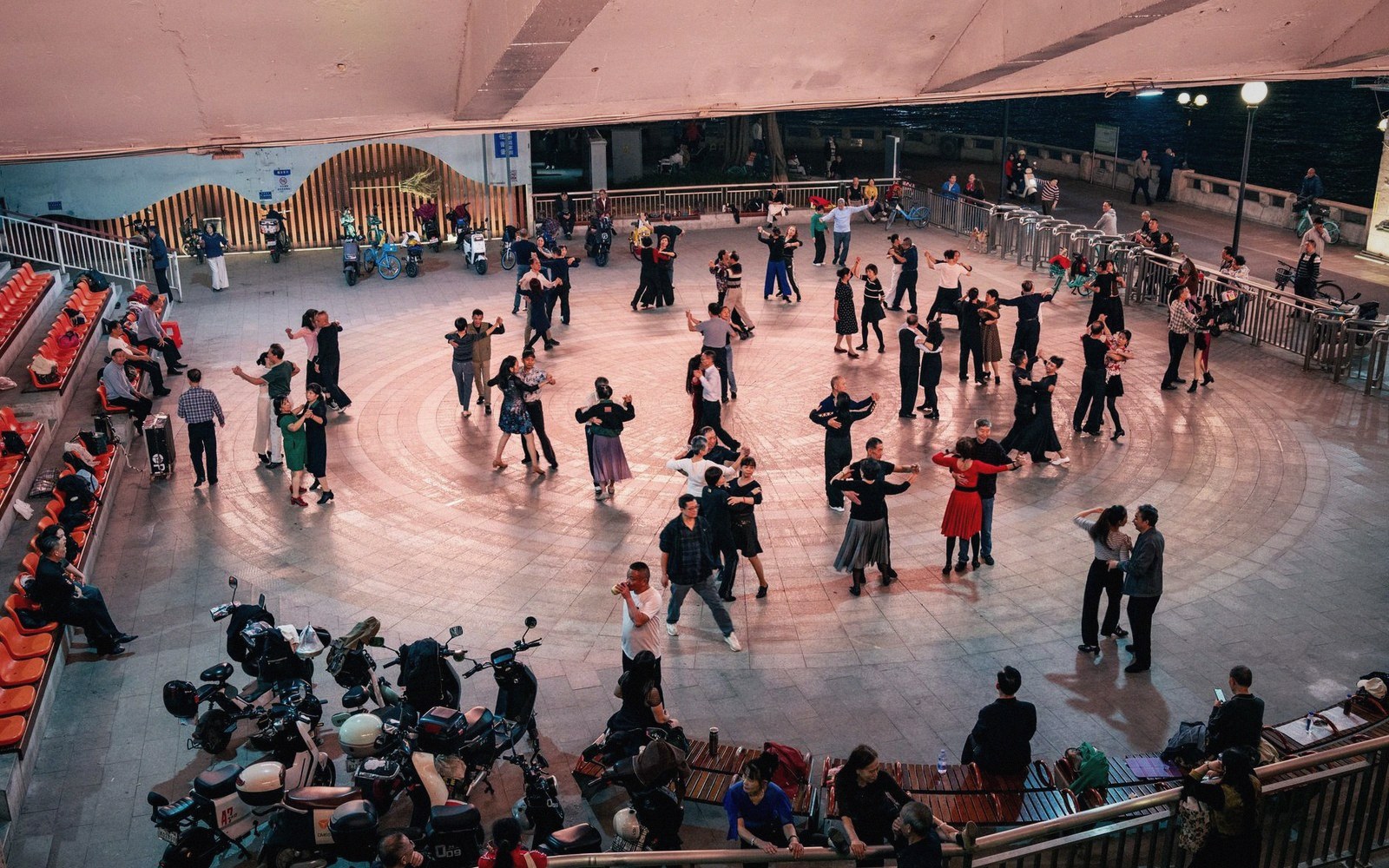
The floor isn't chaos. It has rules — unwritten, unposted, and fully enforceable by consequence.
A busy social floor is a shared resource, and collisions aren't bad luck. They are almost always the product of someone not looking, not adjusting, or assuming the space behind them is empty. That last one is where most trouble starts: dancers who lead big moves — particularly aerials, fast spins, or wide swingouts — without first checking what's behind their partner are not being victimized by a crowded floor. They are creating a hazard on it.
The first skill is peripheral vision. On a packed floor, your eyes should never be locked on your partner to the exclusion of everything else. That sounds counterintuitive — you're dancing with someone — but the lead-follow connection is tactile, not visual. Your hands and frame carry the conversation; your eyes are free to scan. A leader especially needs to track the six-foot bubble around the couple and anticipate where a move will send the follower before initiating it. If that space isn't clear, the move waits or shrinks.
Followers carry spatial responsibility too. A follower's back is the leader's blind spot. When a follower feels a spin or a send-out initiated, checking briefly what's behind them — a fast scan before committing weight — is not optional etiquette; it is self-preservation and neighbour-protection simultaneously. Both partners are responsible for the space the dance occupies.
A crowded floor is not a hostile environment. It is a constraint that forces cleaner technique. West Coast Swing operates in a fixed slot for exactly this reason: a narrow corridor of movement is inherently low-collision. Lindy and East Coast Swing don't work in a slot, but they do respond to compression. A swingout that normally travels three feet can, with good technique, travel eighteen inches. The connection stays intact, the rhythm stays intact, and nobody ends up wearing somebody else's elbow.
Slot discipline means knowing which direction your partnership is travelling at any given moment and owning that direction consistently. Couples who drift unpredictably — changing their line of travel mid-phrase without a clear reason — are the most dangerous people on a floor, because other dancers cannot read them. Predictability is safety. Erratic movement is not spontaneity; it is a technical failure.
The floor also has an informal flow, usually counterclockwise in a large room, inherited from ballroom traditions and reinforced by the practical logic of how bands orient the crowd. Cutting against that flow is not forbidden, but it demands more vigilance. If you're stationary, stay to the inside or the edges. If you're moving, move with the grain.
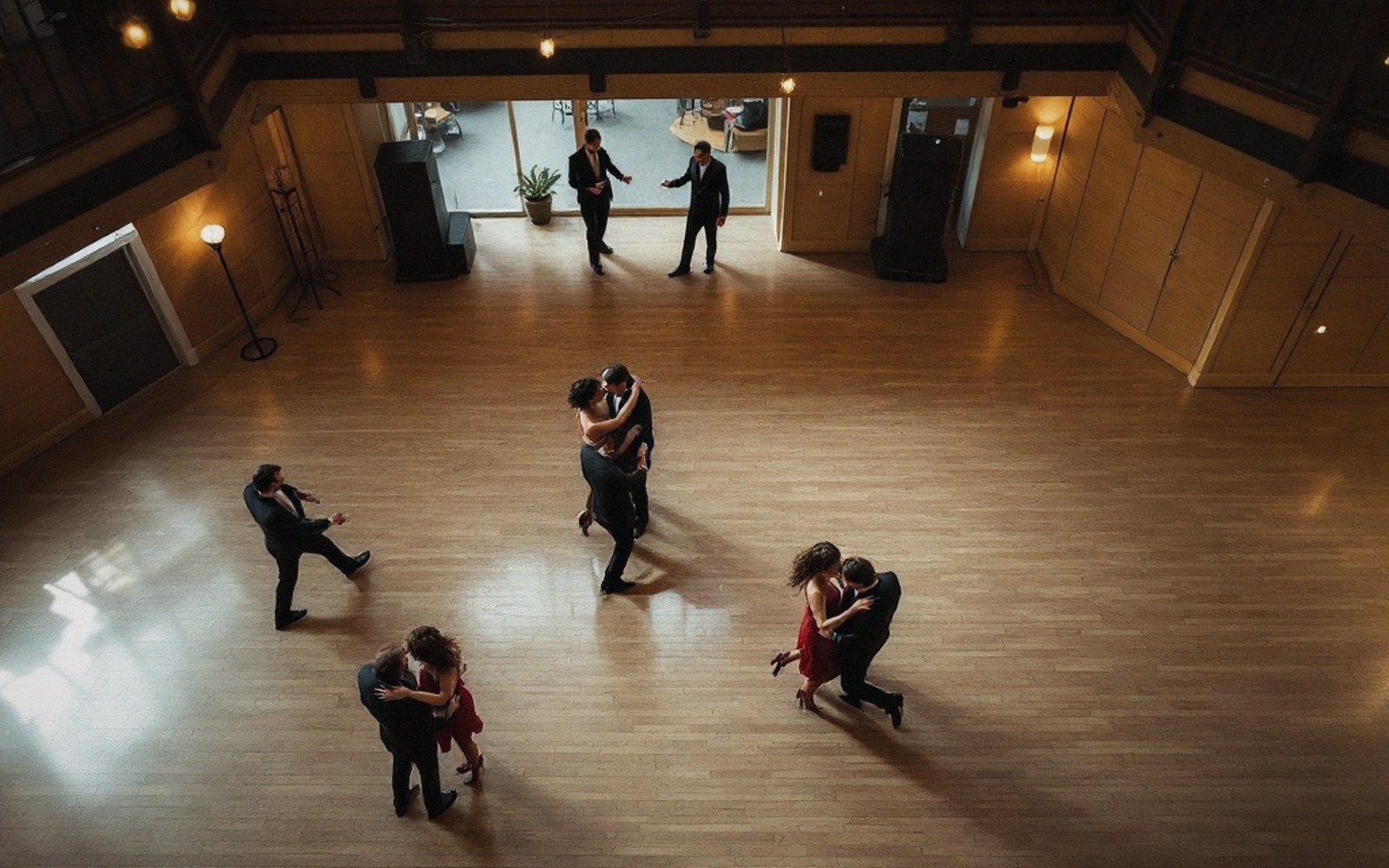
The short answer: the person who had the sightline. If you threw your partner into occupied space, you own that. If you were both stationary and someone else crashed into you, that's on them. The grey area — two couples simultaneously misjudging each other's trajectory — resolves the same way: whoever had the clearer view of the developing problem had more responsibility to prevent it.
A collision is not a social catastrophe. The correct response is immediate: a brief pause, a check that everyone is unhurt, an acknowledgment. No extended apology cycle, no mid-floor postmortem. The social floor is not a court. Make it right, move on.
What the floor does not tolerate well is the leader who performs aerials on a packed social floor. That is not a floorcraft failure — it is a policy failure. Aerials on a social floor put everyone within a ten-foot radius at risk, and the responsibility sits entirely with the person who chose to initiate one. Most events that allow aerials at all confine them to specific jams or edges of the floor. Ignoring that convention is not creative; it is reckless.
Good floorcraft is what allows thirty couples to share a small room and all have a good time. It isn't a courtesy add-on layered over dancing skill. It is dancing skill — the spatial intelligence that distinguishes someone who has genuinely learned to lead or follow from someone who has learned some patterns and is executing them regardless of context.