Constraint as choreography: how a packed ballroom in Southern California produced the most efficient dance on any swing floor.
Newport Beach sits at the southern end of Orange County, and the strip of land that juts into the Pacific just below it — the Balboa Peninsula — became, in the 1930s, one of the most congested dance destinations on the West Coast. The Rendezvous Ballroom, opened in 1928, could hold several thousand people on a summer weekend. The Pavilion Ballroom a short walk away added more. The peninsula itself is narrow, the roads leading in were few, and on a Friday or Saturday night in peak season the floors inside those buildings were genuinely, physically impassable if you tried to dance any way you pleased.
That density was not unusual in the swing era — the Savoy in Harlem, the Roseland in Manhattan, ballrooms across Chicago and Kansas City packed in comparable numbers. What differed on the Balboa Peninsula was a specific policy decision made by ballroom management. Some houses banned the breakaway outright: the open-position move that gives Lindy Hop its expansiveness, its flung-out quality, its air steps. Floor safety and fire code compliance were cited. The practical result was that dancers who wanted to stay in the room had to stay together — literally.
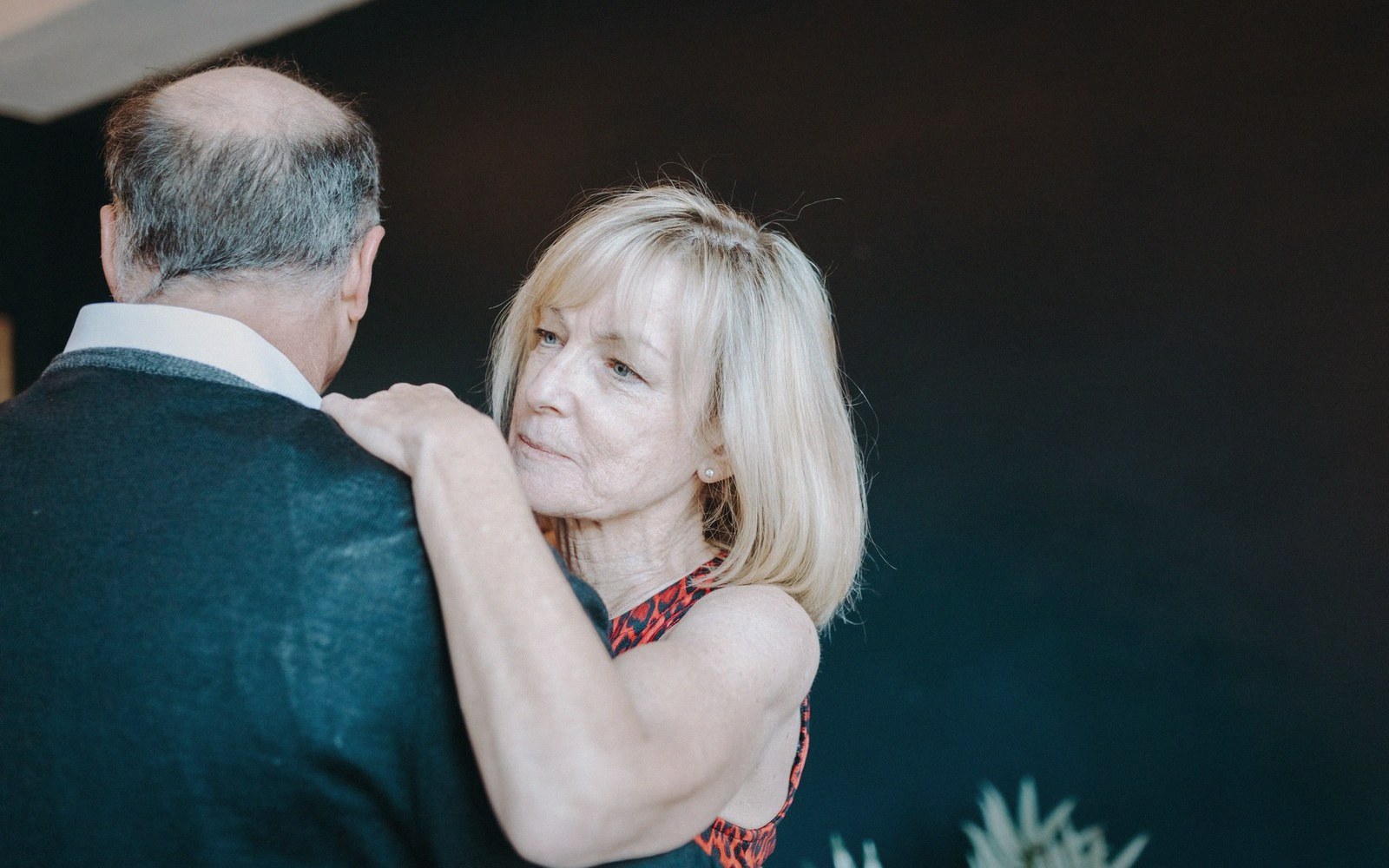
What emerged from that constraint is a dance held chest-to-chest, or very close to it. The partners' torsos touch through the dance; the lead's right hand sits high on the follow's back; the frame is quiet and upright. There are no wild extensions, no kicked-out legs, no need for a radius of clear space. The footwork is continuous, the connection is constant, and the communication between the two bodies happens entirely through the shared contact. The Balboa Peninsula gave this dance its name, and the physical logic of the room gave it its shape.
Pure Bal — the stricter, older form — is eight counts of walking-pace footwork executed in closed position without break. The lead steps in-place on counts one and two, with a slight compression-and-release that sends the follow's weight forward; the couple then travels together through counts three through eight using a distinctive heel-lead, weight-shifting walk. That description makes it sound modest. In practice it takes considerable time to do well, because every idea the lead has — turn, redirect, speed change — has to be transmitted through body contact without the relief valve of an open position. There is nowhere to hide a mistimed signal.
The in-place footwork, sometimes called the "put" in period terminology, is the engine of compression and release. It is what allows the couple to mark the pulse so precisely without stepping outward. On a packed floor, pure Bal is nearly invisible from outside the partnership: two people standing close, apparently doing very little, are actually passing a continuous rhythmic conversation through their sternum contact. The economy of the movement is total.
Bal-Swing — the hybrid form that absorbed open-position figures — developed as the evening or the floor allowed. A couple executing pure Bal can open momentarily for a turn, a come-around, a throwout, then close again without stranding themselves in territory they cannot clear. The transition is seamless when the timing is right, which is why Bal-Swing is what most contemporary dancers learn first: it gives you somewhere to go when you have space and somewhere to retreat when you do not. The social utility of that flexibility is real. A Bal-Swing couple can compress to almost nothing or open for a brief figure and close, adjusting in real time to whatever the floor is doing around them.
Balboa's relationship to tempo is the clearest argument for taking it seriously as a distinct form rather than treating it as a simplified Lindy. Lindy Hop is the trunk from which most other swing dances branch, and at moderate social tempos — say, 150 to 180 beats per minute — Lindy's swingout is efficient, satisfying, and appropriately musical. Above roughly 200 BPM, the swingout starts to compress: the arms shorten, the timing tightens, and the dance loses some of its openness. Experienced Lindy dancers adapt, but the form itself is not designed for the top of the tempo scale.
Balboa has no such ceiling. Pure Bal is mechanically suited to fast tempos precisely because the footwork is so contained. At 200 BPM a Lindy swingout is demanding; at 240 or 260 BPM it is near-impossible for most social dancers. A Balboa couple at 260 BPM is working hard, but the form does not break down — the footwork tightens, the connection intensifies, and the dance becomes more rather than less itself. This is why Balboa floors and Balboa jam circles tend to appear at the fastest songs of the night. The music that clears Lindy dancers from the floor is exactly what Balboa is built for.
For musicians, this creates a real question. A bandleader choosing a tempo for a room with mixed dancers has to know which dances that tempo enables and which it shuts out. A chart played at 220 BPM will thin the Lindy floor and invite Bal dancers into the space they've just opened. Played at 170 BPM, the same room is wide Lindy territory and Bal becomes optional rather than necessary. Neither tempo is wrong; they are decisions with consequences for who dances and how.
Balboa was largely developed by dancers who grew up on those Southern California floors in the 1920s and 1930s. Willie Desatoff is one name the dance's oral history consistently returns to; so is Maxie Dorf, known for his speed and his insistence on precise footwork. The Rendezvous Ballroom is cited in nearly every account of the dance's origins, and period photographs of its floors give you a sense of what the density actually looked like — wall-to-wall, with almost no daylight between couples.
The dance nearly vanished. The war scattered communities, ballrooms closed or converted, and the revival that brought Lindy Hop back in the 1980s and 1990s initially paid Balboa almost no attention. When it did resurface — largely through the work of California-based dancers and the tracking down of surviving original practitioners in the late 1990s — it came back with unusual fidelity, partly because a handful of the original dancers were still alive and could demonstrate what they had actually done. The revival, which got several things wrong in its reconstruction of other dances, had with Balboa the rare gift of living sources.
That history matters not as nostalgia but as mechanics. The specific constraints — the packed floor, the closed position, the banned breakaway — produced a specific solution. Balboa is not a simplified Lindy or a polite Lindy or a Lindy for small rooms. It is a dance that emerged from a different problem, and the footwork, the frame, the tempo range, and the social geometry of the floor all follow from that origin. The fullest rooms in swing dancing are, still, where Balboa makes the most sense.