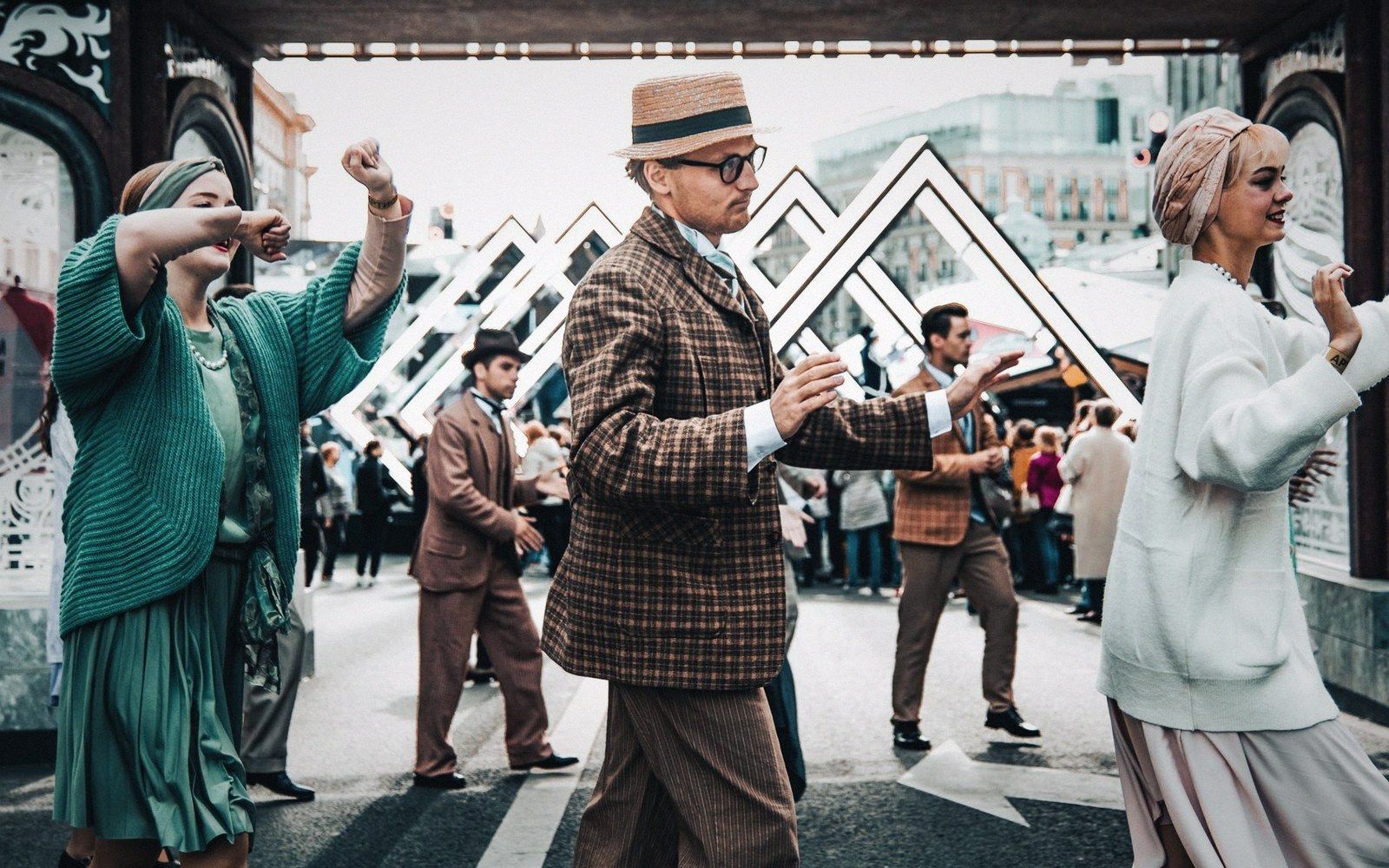
Swing dance came back in the 1980s and 1990s with genuine energy and some significant blind spots — and the blind spots are still shaping how people learn.
The first wave of revival is usually traced to a handful of places: the London swing scene of the early 1980s, Northern Soul's adjacent hunger for older Black American music, and the crucial work of dancers and researchers who tracked down surviving Savoy-era figures while they were still alive and moving. Frankie Manning, who had been out of competitive dance for decades and working for the post office, was rediscovered and began teaching in 1986. His return gave the revival something irreplaceable: direct transmission, not reconstruction from film.
What came back through that contact was real. The architecture of the swingout — the eight-count figure that is, as any serious practitioner will tell you, the organising nucleus of Lindy Hop — survived intact. The pulse survived: the bounce, the compression, the sense that the music lives in the body before it appears in the feet. The vocabulary of aerials, the relationship between solo and partnered work, the improvisational logic — these transferred. The revival did not invent a plausible copy. It recovered an actual lineage.
The problem was what got grafted on. By the mid-1990s — particularly after the Hep Cat clothing brand boom and the "Zoot Suit Riot" cultural moment — swing revival had acquired a costume. Suspenders, two-tone shoes, victory rolls: presentation began substituting for substance. This is not a trivial complaint about dress codes. When aesthetic becomes the primary signal of authenticity, it crowds out the harder question of whether the dancing is actually connected to the music.
The musical relationship is where the gap is most expensive. The original dancers at the Savoy Ballroom were not dancing to a historical period — they were dancing to a live band playing at a tempo chosen for the room, responding in real time to what the rhythm section was doing, interpreting a riff or a break as it arrived. That negotiation — between what the band offers and what the dancer does with it — is the actual substance of the form. The revival, especially in its second wave (the mid-to-late 1990s commercial peak, when swing briefly appeared in car advertisements and major-label marketing), largely replaced live bands with recordings, and replaced musical responsiveness with choreographed set-pieces that worked regardless of what the music did.
The tempo problem is related. Revival-era pedagogy often settled on a comfortable teaching range — roughly 140 to 160 beats per minute — and that range became normalised. The original Savoy repertoire ran considerably higher. More importantly, tempo was a decision made by a bandleader reading a room, not a fixed parameter set for learner comfort. When dancers stop experiencing tempo as a variable they must respond to, they stop developing one of the central skills the dance requires.
There is also the question of attribution. For much of the revival's first decade, the dance's origins in Black American social life — in Harlem, in the specific economic and cultural conditions of that community between the wars — were acknowledged lightly if at all. The form was celebrated while its source was softened into generic period nostalgia. That is not merely an ethical problem; it is a historical inaccuracy that produces a misunderstanding of what the dance is and where its logic comes from.
The revival is not undone — the transmission it carried is genuine and the dance is alive. But the distortions it introduced are structural. A dancer trained primarily on slow recordings in period clothes, doing patterns that work at any tempo to any music, has learned a different thing from what was originally there. The correction is not complicated: listen harder, prioritise the music, learn the count before the costume, and understand that the Savoy was not a theme. It was a place where people worked out something demanding and original, and the work is what survived.