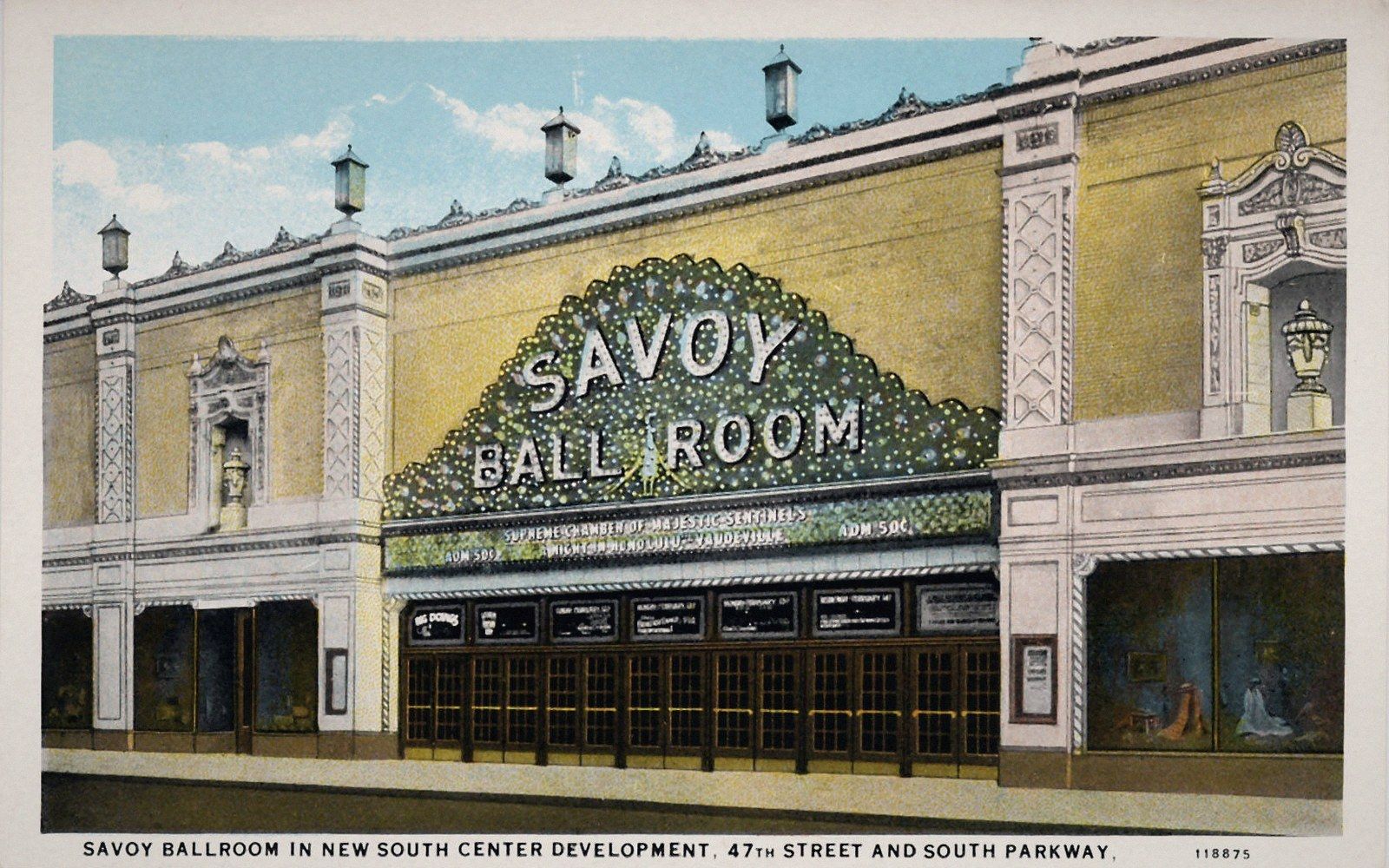
The block-long dance floor where Lindy Hop stopped being informal and started being a language.
The Savoy opened on Lenox Avenue between 140th and 141st Streets in Harlem on 12 March 1926, built by Moe Gale and Jay Faggen with Charles Buchanan running day-to-day operations. It was not a modest room. The ballroom occupied the second floor of the building and stretched for a full city block: a hardwood floor roughly 250 feet long and 50 feet wide, sprung and well-maintained, with two bandstands at either end so that one band could start the moment another finished and the music never actually stopped. Capacity was around four thousand people on a busy night. Admission was low enough that it drew working Harlem — domestic workers, postal clerks, factory hands — not primarily a moneyed crowd, which matters for understanding what the dancing became. A floor where people danced for hours several nights a week, under economic pressure and for genuine pleasure, produces different technique than one where people perform.
The racial politics of the room were specific and worth stating plainly. The Savoy was integrated from the beginning — unusual, and deliberately so, in an era of pervasive segregation. White visitors came to watch and to dance alongside Black New Yorkers. The Savoy's management understood this was commercially useful. It does not follow that the cultural transaction was symmetrical: the dances were created by the Black community that lived in Harlem, shaped on that floor nightly, and then watched, appropriated and often stripped of credit as they moved outward. The Savoy was where the dance was made; it was also a place where that making was immediately visible to people who would carry it elsewhere under different names and with different attribution.
Two bandstands meant that the Savoy ran on musical competition, and this was not incidental to the dancing. The house bands — including those led by Chick Webb for most of the 1930s — had to hold a floor against whoever was booked on the opposite stand. Webb's band was the resident measure against which visiting orchestras were judged, and the head-to-head battles that became known as cutting contests were real events with real stakes. When Benny Goodman's band came to the Savoy in May 1937, an estimated crowd of around four thousand people — double the safe capacity — pressed in. The floor itself was the venue for that kind of musical argument, and the dancers were not passive spectators; the energy on the floor registered in how a band played.
What this meant in practical terms: the bands at the Savoy played for people who were actually dancing, not sitting. Tempos were not abstract. Chick Webb in particular was known for driving a rhythm section at speeds that demanded real physical response, and the dancers on the floor trained against that demand. The music and the movement calibrated each other across years of shared occupation of the same room. This is why what a band does differently for dancers cannot be understood as a theory developed elsewhere and applied at the Savoy — the Savoy was one of the primary places where the practice was worked out in real time.
The names that belong in this history are not incidental decoration. Frankie Manning, who became one of the most influential figures in how Lindy Hop was understood and taught, developed much of his dancing at the Savoy through the 1930s. He was part of Whitey's Lindy Hoppers, the performance troupe organized by Herbert "Whitey" White, who was chief bouncer at the Savoy and who effectively managed a stable of the best dancers on the floor. Whitey's Lindy Hoppers performed in films — including Hellzapoppin' in 1941, which contains footage that revival-era dancers still study — and appeared at the 1939 World's Fair. Other dancers central to this period include Norma Miller, Al Minns and Leon James, all of whom came out of the Savoy floor.
Manning is generally credited with codifying the aerial, the category of movement in which one partner lifts or throws the other. Whether the aerial was truly invented at a specific moment is the kind of question that cannot be answered about a social dance, but Manning's role in developing and spreading the form is documented and real. The point is not to build a mythology around one person but to be precise about where the work happened: it happened on the Savoy floor, in competition, in social dancing, and in the rehearsal process of Whitey's company, which drew from the same pool of dancers.
The Savoy also had a specific area at the corner of the floor near one of the bandstands that became known as the Cat's Corner — the space where the best dancers gathered and competed informally. The existence of a recognized area for high-level social dancing within a public ballroom is itself a fact worth noting: it created a visible standard, a place where the best practice was on display and could be watched, copied, responded to. Technique propagated because the floor was social and the best dancing was not hidden.
The Savoy closed in 1958. The building was demolished to make way for a housing project. There is a plaque. This is not a satisfying ending, and the circumstances of the closure — condemnation proceedings that many at the time considered politically motivated, the displacement of a cultural institution that served a Black community — are part of the record.
What the Savoy produced was not lost with the building. The movement vocabulary that Lindy Hop carried forward, the competitive and social dynamic of the floor, the relationship between a live band and a dancing crowd developed over decades — these survived in the bodies of the dancers who came out of it, in the film footage that documents what the dancing actually looked like, and eventually in the revival that began in the 1980s and accelerated through the 1990s. That revival had its own problems of attribution and appropriation; Harlem and its history were not always adequately credited in the communities that rebuilt the dance. But the origin point remains clear: a block-long floor on Lenox Avenue, open most nights, where people danced because the music was right and the floor held them.