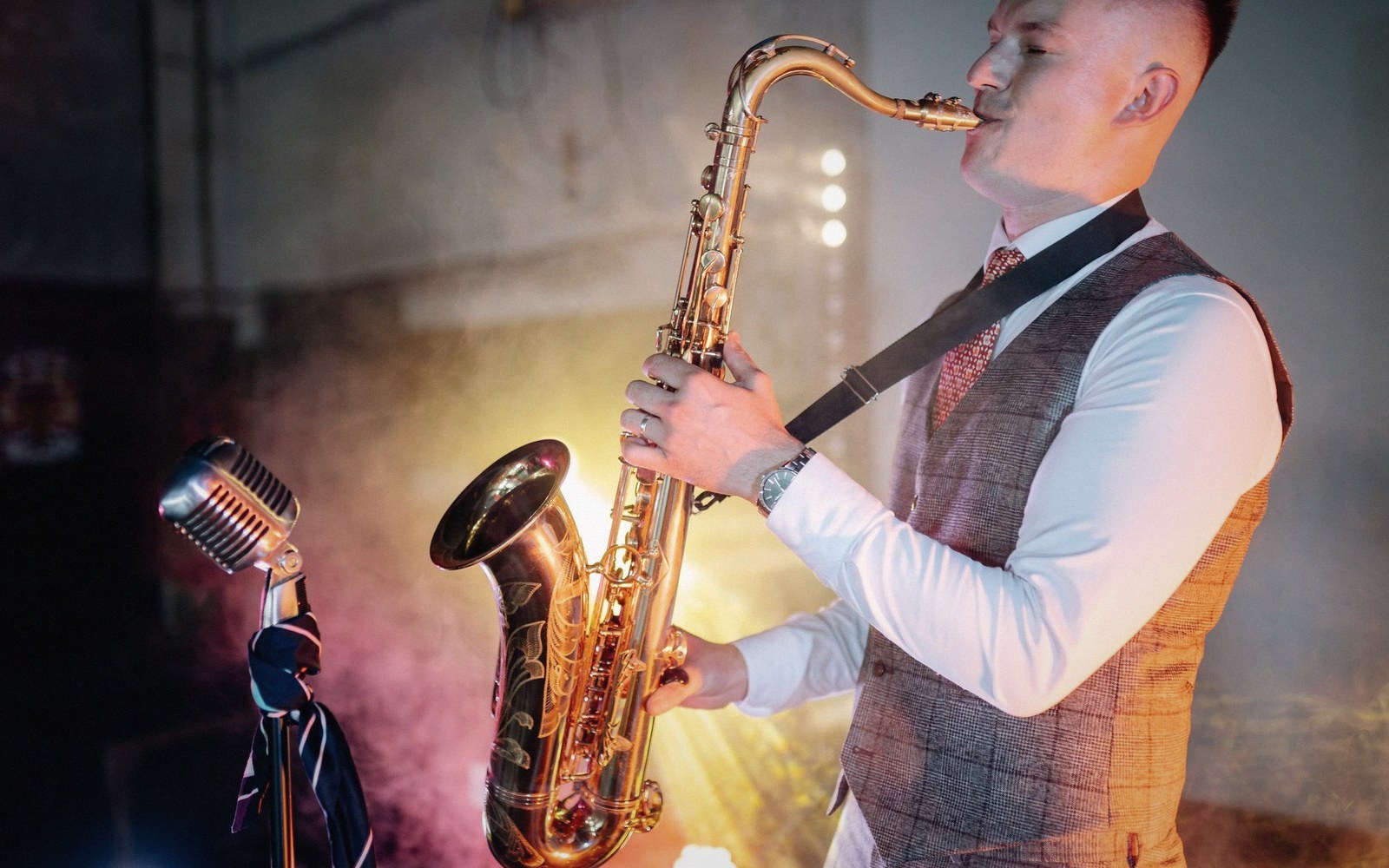
A jazz band playing a concert and a jazz band playing a dance have the same instruments, roughly the same repertoire, and often the same personnel. What changes is the contract. A concert audience wants to be interested; a dance floor wants to be moved — literally, physically moved — at a tempo it can sustain for three to four hours. Everything the band does differently flows from that single difference in obligation.
The most immediate adjustment is tempo, and it is more demanding than it looks. A concert performance can drift: the drummer lays back, the soloist stretches a phrase, the tempo breathes. On a dance floor, drift accumulates into disaster. A tune that begins at 180 beats per minute and creeps to 190 by the second chorus has quietly asked every dancer to run faster without warning them. The body's internal clock is surprisingly precise; dancers feel a ten-BPM difference as a physical injustice rather than a musical decision. The drummer's job, above every other job, is to hold. Not to be mechanical — that is different — but to hold the tempo centre with such authority that the soloists can roam against it and the floor never notices the tension. The rhythm section's actual job is a whole subject, but tempo discipline is where that job meets the dancers most directly.
The working range for most social swing dancing sits between roughly 140 and 220 BPM. Below 140, a Lindy floor starts to feel elastic and vague; above 220, the gap between beats is simply too small for a body to respond before the next one arrives. The band does not need to know the names of the dances being done ten feet in front of the stage, but it does need to know this range exists, and to have an instinct for where the room is comfortable inside it. That instinct comes from watching the floor, which is something concert musicians are not trained to do.
An arrangement written for recording is built around a three-minute commercial constraint that no longer applies on a social floor. An arrangement written for a concert can be as long as the music demands. An arrangement written for dancing has a different brief entirely: it must give the floor enough time to settle into the groove, enough variation to stay interesting, and a clear signal that it is ending.
The settling-in question is more literal than musical. When a tune begins, dancers are still finishing their previous dance, choosing partners for the next, crossing the room. A four-bar intro that goes immediately into the first vocal is fine for a record; live, in a room, it means the first chorus is played to a half-populated floor. Experienced dance-band arrangers build more runway — a longer intro, sometimes a slower build — to give the room time to organise itself. By the time the full band hits, the floor is ready.
Then there is the question of length. A typical recording runs two-and-a-half to three minutes. Social dancers, once they are in a groove with a partner, want more than that: three-and-a-half to four-and-a-half minutes is a common working target, long enough to feel complete, short enough that dancers are still glad to move on. This means the band adds choruses — sometimes a double solo section, sometimes a reprise of the head — without losing shape. The danger of simply adding choruses is that the tune becomes formless, an endless loop that loses the floor's attention because nothing is being built. The best dance-band arrangers solve this by thinking about dynamic arc: they save the full ensemble punch for later in the tune, let it build through solos toward a climax, and end with enough energy that the applause feels earned.
Ending is its own craft. A record can fade; a live band has to stop, and how it stops matters enormously. A clean, confident ending — the kind where every musician knows exactly which beat is the last one — confirms the band's authority in the room. A ragged ending, where players drop out one by one and the drummer takes three extra beats to decide he is done, deflates the room. Dance bands develop a shorthand for endings: the arranger marks them explicitly, the players rehearse them, and on a gig with improvised setlists a rhythm-section signal (often a look from the drummer, sometimes a pre-arranged cue in the final chorus) communicates the form. Dancers feel the difference even when they cannot articulate it.
A single tune is a micro-problem. An evening-length set is a macro-problem of the same kind. A band playing two or three sets across three or four hours needs to think about the room's energy not just tune-by-tune but across the whole night.
The practical architecture that experienced dance bands arrive at independently tends to follow a similar logic. The opening set earns trust: tempos stay moderate, grooves are solid, the band is listening to see who is in the room and how warm the floor is. Playing fast immediately is a common mistake — it reads as showing off, and it exhausts dancers who have not yet warmed up. A room full of shattered dancers by 9 PM is a worse outcome than a room of energised dancers at 11 PM.
Within a set, tempo alternation is not an artistic preference but a physical necessity. Three up-tempo tunes in a row leave the floor gasping; three ballads in a row empty it. Most working dance bands alternate: a medium-tempo number, something fast, something slow, something medium-fast. The band is not following a rule — it is reading a room. If the floor fills when a tune starts and stays full through to the end, that is useful information. If dancers drift off during a slow tune and do not come back immediately when the next one starts, the set is probably running too many ballads, or the slow tunes are too slow.
The late set has its own dynamics. By the final hour, the floor knows the band, the dancers have loosened up, and the energy can finally go where the band wants to take it. This is when the faster tunes land differently — not as a challenge but as a release. Ending the night on a peak is a conventional choice, but it is a convention that exists because it works: dancers leave with the last tune in their body, and that is the thing they remember.
A band playing for dancers has influence, not authority. It cannot make people dance better than they dance; it cannot make a half-empty room feel full. What it can do is create the conditions under which good dancing is possible — stable time, dynamic variety, appropriate tempos, clear endings — and then let the room do what rooms do.
There is one more thing experienced dance bands understand that concert-only bands tend to miss: the music is not the main event. This is a genuinely difficult thing to absorb if you have spent your career playing for listeners. On a dance floor, the music is infrastructure. People came to dance with each other. The band is the reason that is possible, but it is not the reason the dancer is smiling. Accepting this gracefully — playing with full commitment and real musicianship while knowing the focus in the room has moved onto the floor — is a particular kind of professional maturity. The bands that have it are the ones that get asked back.
The practical consequence is restraint in the wrong places and generosity in the right ones. Less soloing that goes nowhere, more time in the groove. Less rubato (the practice of bending tempo expressively), more pulse. Fewer interesting endings that surprise the room, more satisfying ones that tell the room something it already wanted to hear. None of this is dumbing down. It is the difference between a musician who plays and a musician who plays for someone.