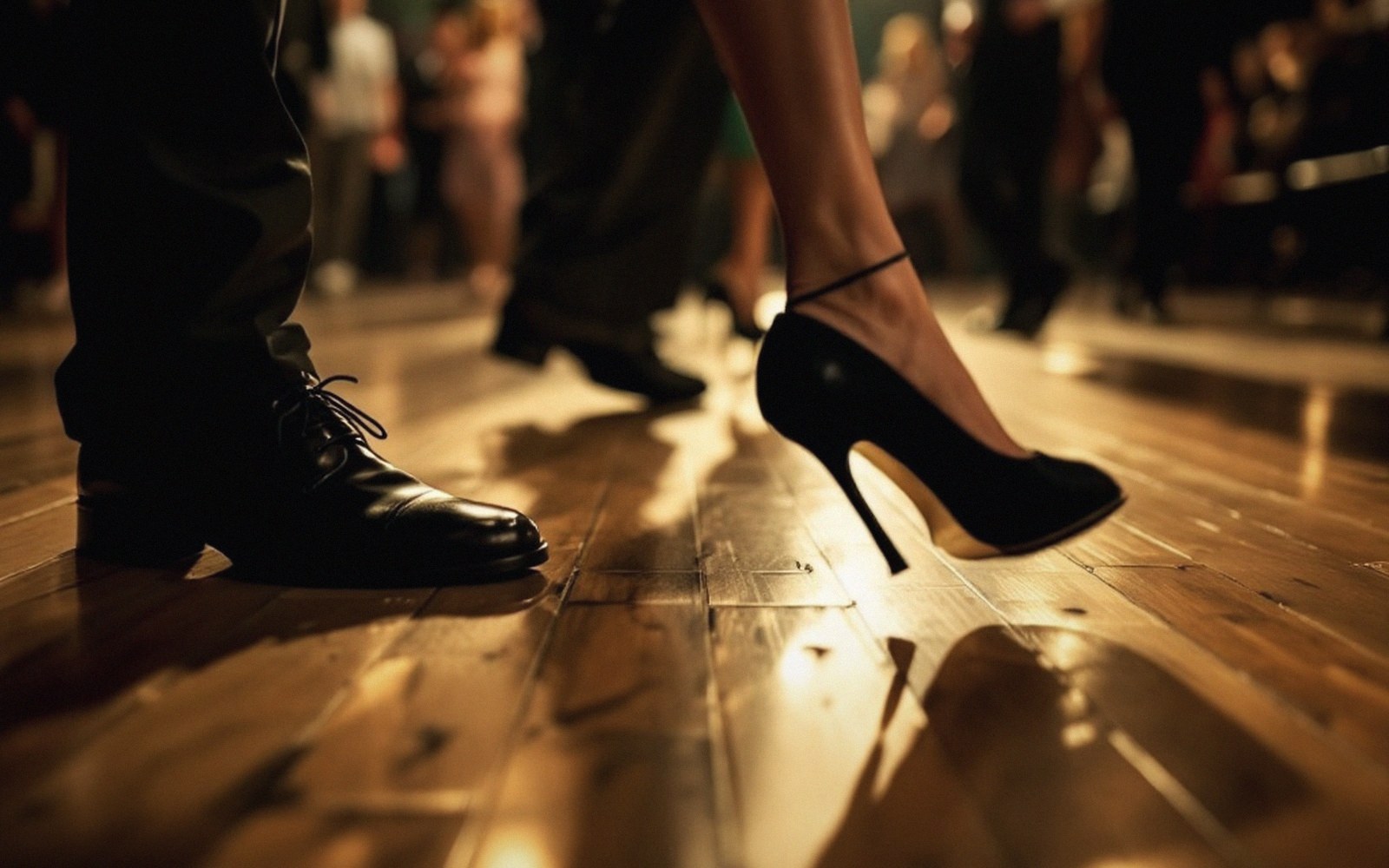
Every other swing dance on the floor is a branch. Understanding why starts with a figure called the swingout and a dance built on a breakaway.
Before Lindy Hop had a name, the partner dances popular in Black Harlem ballrooms in the 1920s were largely closed-position affairs — chest to chest, frame maintained, the couple moving as a single unit through turns and combinations. What changed at the Savoy Ballroom and in the dance halls along Seventh Avenue was a structural decision: the two partners could separate. The leader sent the follower away into open space, then pulled her back. That moment of release — the breakaway — was the hinge on which everything turned.
The name "Lindy Hop" is commonly attached to Frankie Manning, Shorty George Snowden and the other dancers who shaped the form at the Savoy Ballroom in Harlem from the late 1920s onward, in a community that built the dance from the ground up across years of social dancing, contests and improvisation. The "hop" is usually traced to Charles Lindbergh's 1927 transatlantic flight, but the rhythm is the dance's own: where older dances stepped cleanly on the beat, Lindy rhythms syncopated against it. The body doesn't simply mark the pulse — it plays around it, lands between it, suspends over it and returns.
Most social dances are organised in either six or eight counts. Six-count structures — the basis of East Coast Swing in its ballroom syllabus form — cycle faster and work neatly over a shorter musical phrase. Eight-count structures do something more ambitious: they accommodate the phrase shapes of swing music more completely. A standard swing tune is built in eight-bar sections; a swing dance built on eight counts locks into that architecture naturally.
Lindy's core vocabulary runs on eight counts. The swingout — the central, organising figure of the entire dance — is eight counts long. It begins in open position, brings the couple together in closed, and throws them apart again, all inside a single eight-count phrase. The swingout is not a figure you do to a song. It is a complete rhythmic conversation: lead proposes a direction, follower interprets and extends it, the couple orbits each other, and they arrive somewhere new at count eight, ready for the next phrase. That orbit is the thing. The couple doesn't just travel side to side or step in a box — they move in relation to each other, the follower taking a curved path around the leader, both bodies generating and absorbing the shared momentum.
That eight-count swingout is the reason Lindy Hop resists the kind of mechanical reduction that produced East Coast Swing as a teachable alternative. You can extract the footwork, you can count the beats, but the swingout is fundamentally an exchange of energy — a conversation conducted through the connection rather than a sequence executed in parallel. When that transmission works, both dancers feel the pulse in exactly the same place. When it doesn't, you get two people completing a pattern near each other.
The rest of the swing dance family makes considerably more sense when you understand what it is branching away from.
Balboa developed on the southern California coast in the 1930s, where ballroom floors were so overcrowded that a swingout's open-position arc became physically impossible. Balboa is Lindy stripped of its breakaway: close embrace maintained, the conversation shifted inward, happening through subtle body pressure and footwork rather than open-space orbit. It retains the eight-count sensibility, it remains a partner conversation, but it removes the structural feature — separation — that defines Lindy. Understanding Balboa as a response to space constraints and density makes immediate sense; understanding it as a separate invention with no relation to Lindy does not.
West Coast Swing makes the same negotiation differently: it takes Lindy's open-position dynamic but disciplines it into a fixed slot — an imaginary line on the floor that the follower travels along and the leader anchors. The elastic connection of a WCS compression or extension is recognisably descended from the Lindy swingout's moment of separation and return, but the circular orbit has been straightened into a track. The sonic relationship changes too: WCS drifted toward slower tempos and eventually toward a pop and R&B songbook that swing bands rarely touch. The physical roots, though, are visible.
Charleston, older than Lindy as a social form but permanently absorbed into it, is in practice Lindy's solo engine. The Charleston vocabulary — the swivels, the kicks, the Tandem Charleston figures where partners run side by side rather than face each other — lives inside Lindy as a resource the dance reaches for when the tempo climbs or when a phrase invites improvisation. You don't stop doing Lindy and start doing Charleston; you draw on Charleston shapes within the Lindy frame.
Collegiate Shag is the outlier with the clearest explanation: a hop-based, predominantly six-count dance built for very fast tempos where a full swingout would be mechanically impossible to execute cleanly. Shag dancers share Lindy's musical values — they are counting the same music, reading the same phrase structures — but the body mechanics have been reorganised for different rhythmic terrain.
None of this is to say Lindy Hop is superior to the dances it influenced, or that other forms are lesser because they simplified or specialised. A root system is not better than the branches it feeds; it is just prior, and structurally explanatory.
What Lindy Hop carries that its descendants variously traded away is the full combination of features: eight-count phrasing, open and closed positions within the same dance, circular partner orbit, syncopated footwork, and the improvisational culture that makes those features interact differently every time. These are not style choices — they are structural properties, and the other swing dances emerge precisely from decisions to keep some of those properties and drop others.
A musician playing for a mixed floor carries this history in practical form. A Lindy-friendly tempo sits roughly in the range where a swingout is physically possible to execute with real momentum — broadly speaking, somewhere between about 140 and 200 beats per minute, with dancers calibrating to tempo differently at either end of that range. Play much faster than that and the floor shifts toward Shag or Charleston. Play slower, and WCS dancers wake up. The music doesn't determine which dance happens — dancers make that choice — but tempo narrows the options in ways that follow exactly the structural history above.
The social floor at any competent swing event is, in this sense, a working demonstration of the family tree. Watch long enough and you see the decisions each dancer has made about which features of the original to keep, which to discard, and which room the music is offering them tonight. Lindy Hop doesn't impose itself on that floor. It just explains it.